

The Research Society for Korean History of Philosophy Successfully Concludes Its Spring 2026 Academic Conference
- 글번호
- 427247
- 작성일
- 2026-07-21
- 수정일
- 2026-07-23
- 작성자
- 홍보과 (032-835-9490)
- 조회수
- 216
The Research Society for Korean History of Philosophy Successfully Concludes Its Spring 2026 Academic Conference
"20th-Century Korean Philosophy: Turbulent Era, Resonances of Thought" — Illuminating the Flow and Future of Modern and Contemporary Korean Philosophy
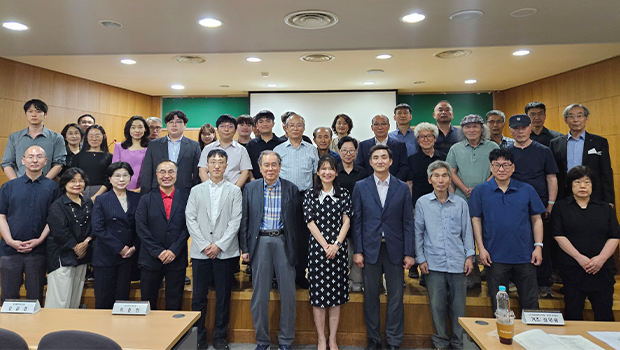
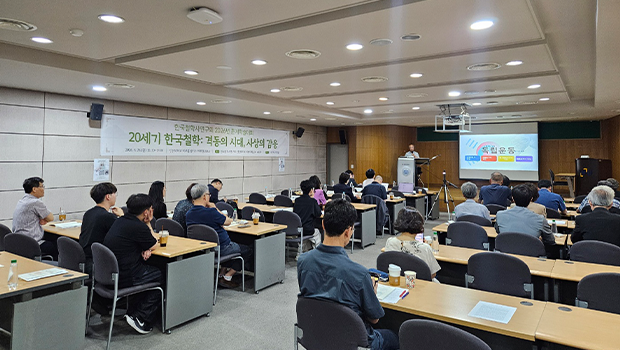
The Research Society for Korean History of Philosophy (President Yoon-kyung Kim, Professor of Ethics Education at Incheon National University) successfully hosted its Spring 2026 Academic Conference on June 26 at the Mirae Hall in Incheon National University’s Michuhol Campus.
Under the main theme "20th-Century Korean Philosophy: Turbulent Era, Resonances of Thought," the conference comprehensively examined the formation and evolution of Korean philosophy amid the turbulent modern and contemporary history of Korea through the perspectives of Confucianism, Buddhism, and Daoism. Attended by academic researchers, graduate students, and experts, the event served as a platform for active scholarly exchange on inheriting, reinterpreting, and discovering the contemporary significance of traditional thought.
The conference commenced with an opening ceremony followed by a keynote address by Tae-yong Seong, Chairman of the Korea Yeonjeong Institute (former Professor at Konkuk University). In the first session focusing on 20th-century Korean Confucian philosophy, presentations included "The Life of Simsan Kim Chang-suk, an Action-Oriented Confucian Scholar" by Professor Young-seong Choi of Korea National University of Cultural Heritage, and "Myeon-u Gwak Jong-seok's Theory of Four-Seven (Four Clues and Seven Feelings) — A Culmination of the Four-Seven Debate" by Professor Je-sung Bae of Sungkyunkwan University.
In the second session, various presentations centered on 20th-century Korean Buddhist and Daoist philosophy. Professor Beom-sik Park of Seoul National University presented "Buddhist Understanding of the World and Interpretation of Religious Texts: Re-illuminating the Thought of Tanheo," while Professor Seong-min Park of Seoul National University presented "The Life and Thought of Gyeongheo: Based on Knowledge and Association," discussing key issues in modern and contemporary Buddhist thought. Furthermore, Professor Dae-seung Lee of Wonkwang Digital University presented "Modern Reinterpretation of Jeon Byeong-hun's Daoist Thought and Reconstruction of Inner Sageliness and Outer Kingliness," and Professor Yoon-kyung Kim of Incheon National University provided an in-depth look at the development and characteristics of 20th-century Korean Daoism through "Bong-woo Kwon Tae-hoon's View of Korean Daoism."
Distinguished discussants participated after each presentation to lead in-depth discussions: Professor Won-jun Lee of Gongju National University, Professor Sun-kyung Lee of Dongguk University, Professor Tae-soo Kim of Seoul National University, Professor Gil-san Lee of Namseoul University, Professor Woo-kwon Na of Korea University, and Professor Si-cheon Kim of Soongsil University. A general discussion moderated by Professor Seong-hwan Cho of Wonkwang University synthesized the presentation topics, engaging participants in a broad dialogue on major achievements and future research directions for 20th-century Korean philosophy.
This conference held significant value in examining from various perspectives how traditional philosophy adapted to changing times and generated new thought patterns, centering on representative modern and contemporary Korean thinkers such as Gwak Jong-seok, Kim Chang-suk, Gyeongheo, Tanheo, Jeon Byeong-hun, and Kwon Tae-hoon. Attendees shared a mutual understanding that 20th-century Korean philosophy should be understood not as a simple continuation of tradition, but as a living flow of thought continuously reconstructed through historical experiences, including colonization, liberation, industrialization, and globalization.
"20th-century Korean philosophy represents an intellectual heritage that sought our society's identity and direction by reinterpreting traditional thought amidst the upheavals of modern Korean history," stated Yoon-kyung Kim, President of The Research Society for Korean History of Philosophy. "We hope this conference serves to broaden the horizons of Korean philosophy research and highlight its academic and practical value in the era of K-culture."
The conference was co-hosted by The Research Society for Korean History of Philosophy and the Department of Ethics Education at Incheon National University, with support from the Korea Yeonjeong Institute. The Society plans to continue hosting scholarly exchanges to further explore the traditions and modern implications of Korean philosophy in depth.
- 첨부파일
- 첨부파일이(가) 없습니다.